AI + Outbound = Strategic Account Growth

The team at Altus Alliance recently pulled together their Revenue Roundtable to discuss and debate this topic. Below is the summary of those findings and discussion. Body: Doug Schulze, Contributors: Kyoo Kim, Lawrence Korchnak, Keith Kostrzewski, Aaron Rosenstein, Darrin Fagan.
The Reality: Outbound Isn’t Dead—But It Is Broken
“Cold outbound has not disappeared, it has simply become far less effective for most companies.” Doug Schulze, Altus Managing Partner
Average cold email response rates have declined to approximately 0.5%–1% across industries (Salesloft / HubSpot, 2024–2025). While top-performing teams still achieve materially better results under very specific conditions. Most organizations, however, are operating outside those conditions.
“Cold outbound is tough when you don’t have product-market fit or a clear persona. Without that, you’re just spinning your wheels.” Lawrence Korchnak, Altus Strategic Partner
At a strategic level, outbound is not a single discipline. It consists of two fundamentally different operating models, each requiring distinct capabilities, economics, and expectations.
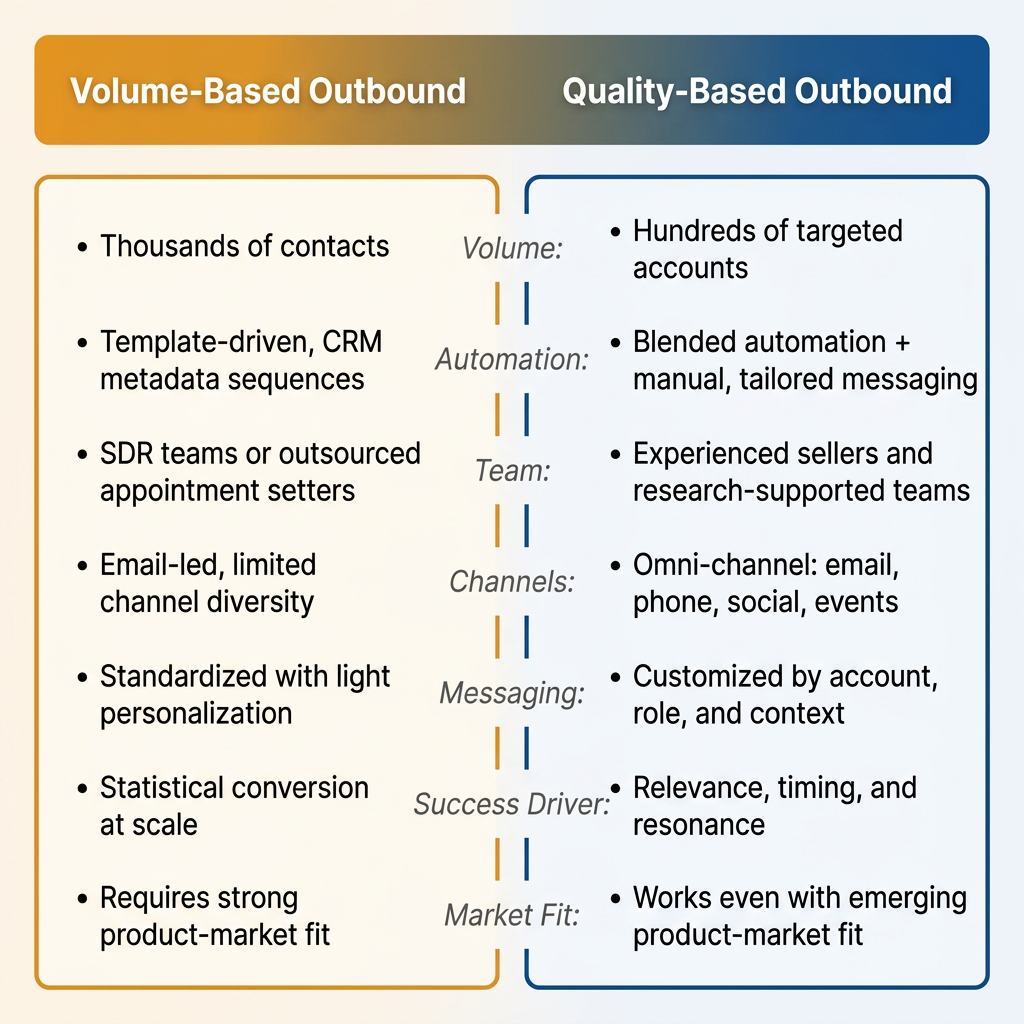
Product-Market Fit Determines the Model
The strength of product-market fit (PMF) should dictate which outbound model a company adopts.
Volume-based outbound is only effective when true PMF exists—specifically when:
The company targets a large total addressable market
There is a high density of similar buyers (repeatable ICP)
Buyers share a clear, urgent, and acknowledged pain
The solution is meaningfully differentiated, not incrementally better
The value proposition delivers fast, provable ROI
In these conditions, messaging requires less customization because the pain is already well understood, and scale compensates for lower engagement rates.
The challenge is that many organizations overestimate their level of PMF. In practice, a large percentage of B2B companies operate in partial or pre-PMF environments, yet deploy volume-based outbound strategies designed for mature markets.
This mismatch is the root cause of:
Declining response rates
“Outbound is dead” sentiment
SDR inefficiency
Increasing brand fatigue among buyers
The Market Cycle: Outbound Moves in Waves
Outbound effectiveness follows predictable cycles, similar to other marketing and media channels:
A new channel or tool emerges → engagement is high
Early adopters gain disproportionate advantage → no noise
Adoption scales → saturation increases
Buyer fatigue sets in → effectiveness declines
We have seen this pattern repeatedly:
Network television advertising (mass reach → ad blindness)
Direct mail (high response → junk mail fatigue)
Banner ads (high CTR → near-zero engagement)
SEO and content marketing (early advantage → commoditization)
LinkedIn outbound (initial success → widespread saturation)
Today’s outbound environment reflects the late stage of one such cycle.
The End of the Sequencing Era
Highly automated, sequence-driven outbound (once highly effective) has reached diminishing returns. Buyers quickly recognize templated outreach, even when lightly personalized with CRM data. “The market is voting with their lack of action as open rates are dropping because buyers recognize templated outreach immediately.” Kyoo Kim, Altus Managing Partner
That said, outbound itself is not failing. What continues to work is:
Insightful, knowledge-driven messaging
Thoughtful, empathetic outreach across channels
Communication that demonstrates a clear understanding of the buyer’s context
The next phase is widely expected to be Agentic Outbound, where AI can deliver high-quality, deeply personalized messaging at scale across channels. While progress is rapid, this capability is not yet fully mature.
In the interim, organizations still need to generate pipeline efficiently.
The answer is not complex, but it is demanding. This middle phase and era requires low-volume, high-quality Precision Outbound. Top-quartile teams achieve 3–5%+ response rates through targeted personalization. In Altus client engagements, we often see 10%+ response rates with manageable account volume in the campaign. Recent perspectives from Stage 2 Capital similarly suggest that top-performing teams focus on fewer than 50–75 accounts per representative.
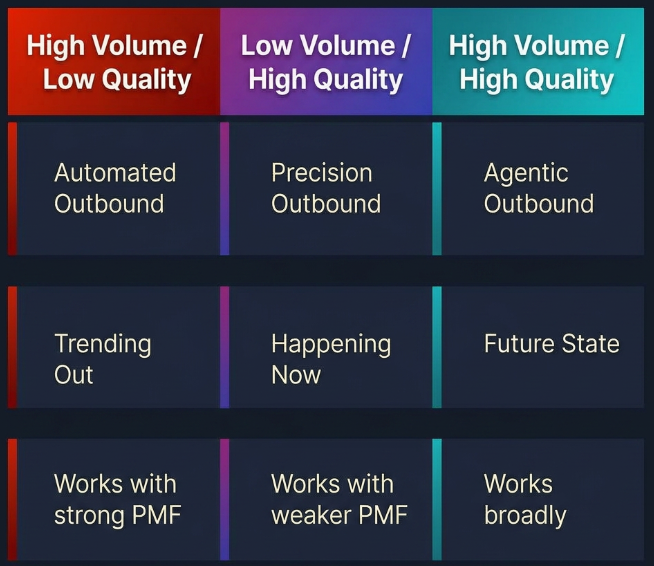
3 Basic Strategy Types:
If the prior era was defined by:
High Volume / Low Quality,
and the future promises:
High Volume / High Quality (Agentic),
the current reality is:
Low Volume / High Quality … Precision Outbound
Winning Now with Precision Outbound
Precision Outbound remains underutilized. Organizations that adopt it not only improve engagement rates but also build stronger commercial foundations.
Earning engagement requires true precision and most sales organizations believe they are delivering highly personalized outreach. In reality, analysis of CRM activity and messaging templates often reveals that the vast majority of communications are highly similar across accounts and personas.
A simple test applies: If the message could be sent to another prospect with merely a name change, it is not precise or truly personalized. “Three or four extra minutes of real research can completely change whether someone opens your email.” Altus Strategic Partner, Keith Kostrzewski
Effective precision messaging requires:
Understanding the company, its market, and its priorities
Aligning to the specific role and responsibilities of the buyer
Demonstrating insight, not just awareness
This level of effort is time-consuming and requires discipline which is why few organizations execute it consistently. Yet it is increasingly the only approach where buyers engage.
Focus Is No Longer Optional
A consistent issue across B2B companies is lack of focus. Organizations attempt to target too many industries, segments, or use cases without allocating sufficient resources to any one area.
Of the revenue challenged companies we see, fewer than 10% allocate adequate resources to fully pursue each target segment.
Precision outbound requires:
Narrowing the target market significantly
Prioritizing a defined set of accounts
Aligning internally on a clear Ideal Customer Profile (ICP)
This often translates into focusing on hundreds (not thousands) of accounts, and in many cases a rotation of ~50 accounts per seller for outbound.
Buyers must feel that your organization is built specifically for them. Without brand recognition, this level of relevance is not optional, it is required. “AI lets you go beyond surface personalization—into real company context, signals, and relevance.” Keith Kostrzewski
From Target Accounts to Strategic Accounts
Precision outbound forces a more rigorous definition of the customer base. Rather than asking, “Who can we sell to?”, organizations begin asking: “What should our ideal customer portfolio look like?”
This shift drives:
Cross-functional alignment (sales, marketing, product, finance, customer success)
A focus on lifetime value, not just near-term revenue
Improved operational efficiency and profitability
The most effective engagements involve the entire organization in defining what constitutes a strategic account, not just a winnable deal.
Preparing for the Agentic Future
Precision outbound is not just a current solution to new strategic customers, it is a prerequisite for what comes next.
As with any system, optimization must precede automation. The processes, messaging frameworks, and targeting discipline developed through precision outbound become the foundation for future AI-driven scale. Organizations that invest now are effectively building the playbook that can later be automated and amplified. “Agentic AI initially will amplify what’s already there, but if the fundamentals aren’t right, you just fail faster.” Kyoo Kim
Salesforce just announced it has peeled off the UI and is licensing the core infrastructure and platform as components for agents to leverage execution. With the changes taking place in 2027 and if you can properly prepare for the vision internally, the impact to costs and results will be dramatic. “Think of Agents not as a tool, but as a digital employee performing specific revenue tasks.” Lawrence Korchnak
The Core Elements of Precision Outbound
Executing precision outbound requires a structured approach:
Define target account criteria based on ICP and strategic fit
Use AI and data platforms to identify and prioritize matching accounts
Map key stakeholders within each account (account-based approach)
Conduct targeted research on each account, its market, and its decision-makers
Develop tailored messaging strategies aligned to each stakeholder
Monitor for buying signals and trigger events
Design a coordinated, multi-channel outreach sequence (email, phone, social, etc.)
Execute a disciplined cadence of 10–15 touches per account
Progress engaged prospects through the pipeline
Nurture non-responders with relevant, role- and industry-specific content
Closing Perspective
Precision outbound delivers more than improved response rates. It enables organizations to build a more strategic, more aligned, and more profitable customer base. A revenue base defined by repeatable problems, known value, and scalable growth potential.
There is significantly more depth behind the structure, systems, and operating model required to execute effectively. For organizations looking to modernize their outbound strategy, this approach often represents a critical inflection point.
If this perspective aligns with your current challenges, Altus has developed practical frameworks and playbooks to help teams transition successfully. Let me know if you would like me to send you templates that help facilitate an effective outbound strategy. doug@altusalliance.com