Is your business AI-invisible?
Why GEO is the New Battleground and How to Get in the Fight
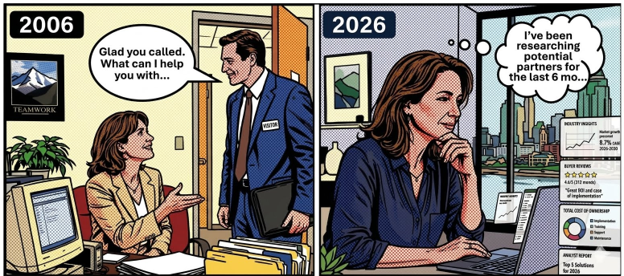
In my last piece, Prospects Don’t Want To Talk With You…Yet!, we looked at a sobering reality: 70–80% of the B2B buyer’s purchasing journey is over before they ever reach out to your sales team. We discussed how prospects are hiding in the shadows, conducting deep-dive research, and vetting your company way before you even know they exist.
Buyers are no longer just hiding from your sales staff; they are using AI-powered tools to deep-dive into your company, your products, and your reputation before you even know they are looking. Recent data indicates that nearly 75% of B2B decision-makers now use AI to vet a company before ever initiating contact. Think about how your personal shopping process has changed over the last 20 years…it’s the same for B2B.
These prospects aren't scrolling through Google’s traditional blue links anymore, "hunting and pecking" for information. Gartner reveals that 40% of B2B buyers now prioritize AI-powered Answer Engines over traditional search results when identifying new vendors. This shift has created a Zero-Click reality: more than half of all searches now end without a single click to a website. After all, why would a buyer navigate to your site when they can get a definitive, summarized answer directly on the search results page?
When a B2B buyer asks a search engine, “Who is the most reliable partner in [Industry] that can address [Problem]?”—if the AI doesn’t pull your name into that summary, you don’t exist. You are AI-Invisible.
Artificial intelligence is no longer a future trend — it is a core business capability. Companies that strategically adopt AI can improve productivity, reduce costs, and create better customer experiences. Companies that ignore it risk falling behind.
The Shift: From Relevancy to Authority
For decades, we’ve been told to focus on SEO (Search Engine Optimization) to increase visibility and drive leads to your site. But the playing field has shifted; we are now in the era of GEO (Generative Engine Optimization).
While SEO was about being one result in a library of many relevant links, GEO is about being the answer provided by the librarian. Google is no longer just a search engine; it is an Answer Engine. If your digital footprint isn't structured to feed that engine, the AI will simply summarize and showcase your competitor's information instead of yours.
In traditional SEO, a weak website might just rank lower on the search results page. In the AI era, a weak digital presence means you are completely left out of the conversation. In an analysis of over 40K businesses, Gumshoe , a leading AI visibility platform, has found that over two-thirds (68%) of businesses show up in less than 20% of the AI answers to key questions.
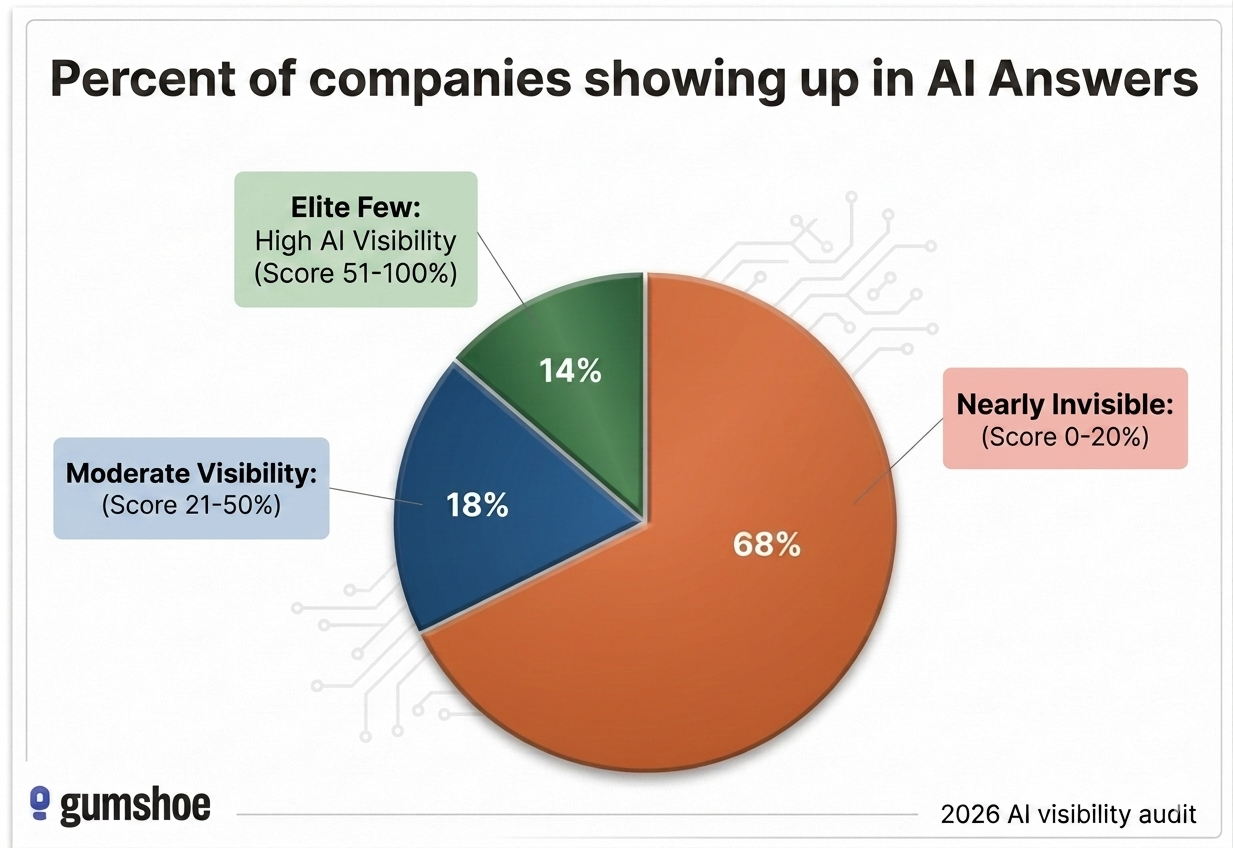
"The data doesn't lie: most companies are practically invisible to modern buyers. If your digital presence isn't explicitly optimized for generative engines, you're leaving your visibility entirely up to chance."
— Jim Watson, CRO of Gumshoe.ai
The Entity Advantage: Building Trust in the Digital World
How does an AI know who to trust? It doesn't look at your flashy stock photos or your Home Page filled with platitudes about superior products and customer service excellence. AI models prioritize Entities—an entity is a verifiable fact: a specific person, a physical location, a certified expert, a measured result or a professional credential.
When a B2B prospect asks an AI for a recommendation, the AI doesn't just read your website; it performs a digital background check. It is looking for three specific signals to prove you are an authority:
Expert Vocabulary: AI looks at the words surrounding your name. If you claim to be an expert in your field, the AI expects to see high-level technical terminology and industry-specific vocabulary—not just generic marketing fluff. If the vocabulary doesn't match the level of expertise claimed, the AI moves on.
The Trust Factor: The AI cross-references your claims against independent sources across the web, such as LinkedIn, professional directories, industry news, and third-party publications. When these sources confirm your specialized certifications, knowledge, or cited expertise, the AI trusts your company enough to cite you as a primary source.
Machine-Readable Verification: AI is a pattern-recognition engine that favors certainty over guesswork. While humans read your website to get a feel for your company, AI "crawls" the underlying structure to find validated proof of your claims. By aligning your digital footprint with the technical standards AI understands, you move from being a "claim" in its system to being a "verified fact." You are effectively translating your decades of industry experience into a language that an algorithm can trust and recommend with high confidence.
Getting in the Fight: Five Tactical Moves
If you suspect your business is currently AI-Invisible, you need to pivot your strategy immediately. Here is how you get in the fight:
Speak the AI’s Language: Use FAQ Schema Markup in your site’s code to pre-digest your data. This technical shorthand allows the AI to skip the line and feature your answers instantly.
Deploy High-Value FAQ’s: Beyond the technical code, your visible website content should follow a strict Question-Answer format. By explicitly answering the high-intent questions your prospects are asking (e.g., “How do I solve X in a Y environment?”), you provide the AI with the perfect snippet to pull as its definitive answer. This turns your site into a technical resource rather than just a digital brochure.
Claim Your Digital Territory: Create a 150-word Master Summary on your website that is dense with facts, not fluff. Provide specifics like years in operation, markets served, and key partnerships.
Weaponize Your Case Studies: AI thrives on a Problem-Solution-Result loop. A quality case study identifying a specific challenge, your unique intervention, and the measurable outcome provides the data points an AI needs to recommend you.
Build the Citation Loop: When reputable industry groups or trade associations mention your expertise, it acts as a verified badge. These third-party citations are the social proof of the generative age.
Be an Expert, Not a Vendor
The 70–80% of buyers who are researching you right now are looking for an expert with knowledge of the products and/or services they need, not a generic vendor. If you aren't visible to the AI tools they use, you've lost the deal before the first handshake.
It’s time to stop fighting for rankings and start fighting for the answer. Don't let your reputation be erased by an algorithm—build an authoritative digital footprint that ensures your business is seen, cited, and sought after.
________________________________
Want to evaluate where AI can create value in your sales and marketing organizations? Drop us a line at info@altusalliance.com and we’ll hook you up with our Altus 21 HPR readiness assessment.